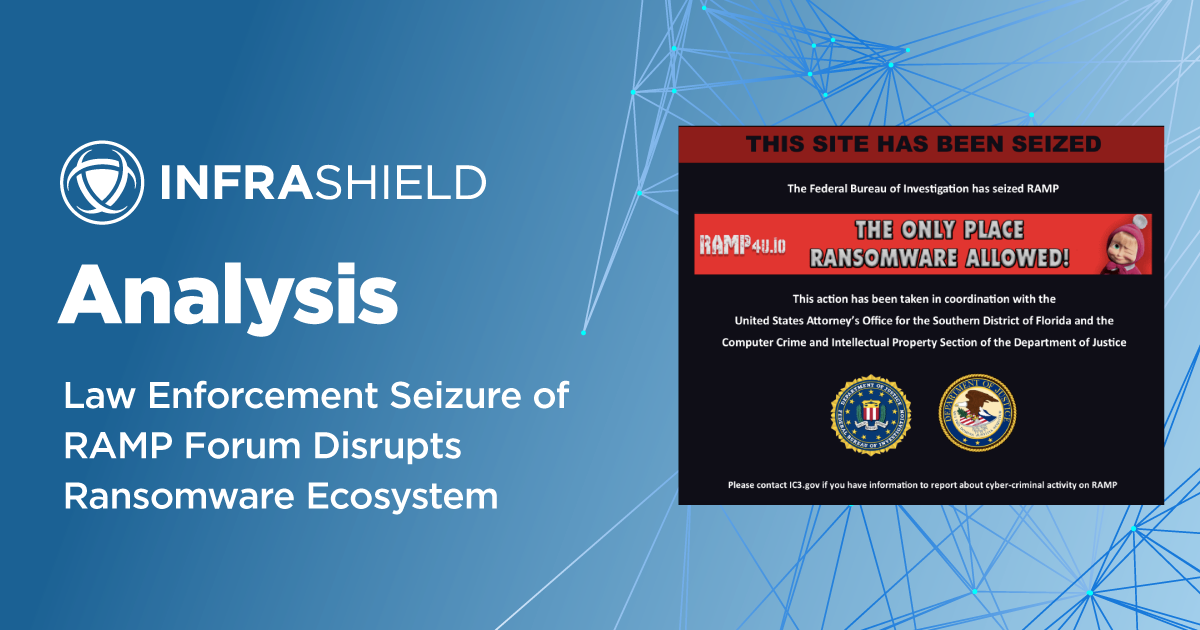
On January 28, 2026, U.S. law enforcement seized the Russian-language cybercrime forum known as RAMP, thereby disrupting the most significant coordination hub in the global ransomware ecosystem. The takedown represents one of the largest blows to the underground cybercriminal economy in recent years, rivaling the takedown of the XSS cybercrime forum in 2025.
Summary
On January 28, 2026 U.S. law enforcement seized the Russian-language cybercrime forum known as RAMP, thereby disrupting the most significant coordination hub in the global ransomware ecosystem. The takedown represents one of the largest blows to the underground cybercriminal economy in recent years, rivaling the takedown of the XSS cybercrime forum in 2025. “This operation removes a major load-bearing pillar of the ransomware economy,” said Mark Rorabaugh, President and CEO of InfraShield. “But defenders should not mistake disruption for defeat. Ransomware is adaptive by design, and the threat to critical infrastructure remains acute.”
While other forums shunned ransomware business after the Colonial Pipeline hack in 2021, RAMP emerged to serve as critical infrastructure for the extortion economy. RAMP became the only cybercrime community that facilitated affiliate recruitment, ransomware-as-a-service (RaaS) advertising, access brokerage, tooling exchanges, and reputation building.
Over time, it became a central meeting place for activity linked to high-profile ransomware groups, including ALPHV (BlackCat), RansomHub, LockBit, Qilin, and DragonForce. The forum’s seizure is being hailed as a victory for law enforcement, yet cybersecurity experts caution that the victory may be fleeting.
“This operation removes a major load-bearing pillar of the ransomware economy,” said Mark Rorabaugh, President and CEO of InfraShield. “But defenders should not mistake disruption for defeat. Ransomware is adaptive by design, and the threat to critical infrastructure remains acute.”
Why RAMP’s Takedown Matters
RAMP was not your typical cybercrime forum, focused on data leaks, malware kits, and general cyber fraud activities. It was an extortion-focused hub built to accelerate RaaS activity and foster collaboration between threat groups. By rewarding RaaS gang brand visibility and self-promotion, the platform encouraged new and mid-tier actors to publicize their services, recruit affiliates, and build reputations in full view of competitors, researchers, and inevitably, law enforcement.
This platform architecture significantly lowered the barriers to entry for cybercriminals looking to graduate into more lucrative and professionalized cyber-extortion rackets. InfraShield’s assessment finds that RAMP’s removal will have uneven consequences across the ransomware landscape:
- Emerging criminal operators will struggle to rebuild visibility and credibility without a centralized venue for recruitment and advertising.
- Access brokers who sold stolen credentials and exploited entry points will lose a primary channel, forcing them to migrate to other unproven platforms and fragmented networks.
- Top-tier ransomware groups like Shiny Hunters, Cl0p, Akira, and others are expected to experience minimal disruption, having already developed robust and proprietary cybercrime infrastructures.
- Defenders may lose short-term insight into underground movements, as conversations migrate to smaller and more restrictive networks.
“RAMP was not just a forum; it was an onboarding runway and accelerator for aspiring extortionists,” Rorabaugh said. “Its removal introduces friction for less mature actors, but it will not stop established sophisticated groups from operating. In fact, many elite RaaS gangs like Akira and Cl0p had minimal to no visible presence on the forum.”
Regardless, U.S. authorities reportedly now possess unfiltered access to all historical forum data, based on heated forum chatter that has emerged on other functioning Russian-language cybercrime forums and Telegram channels.
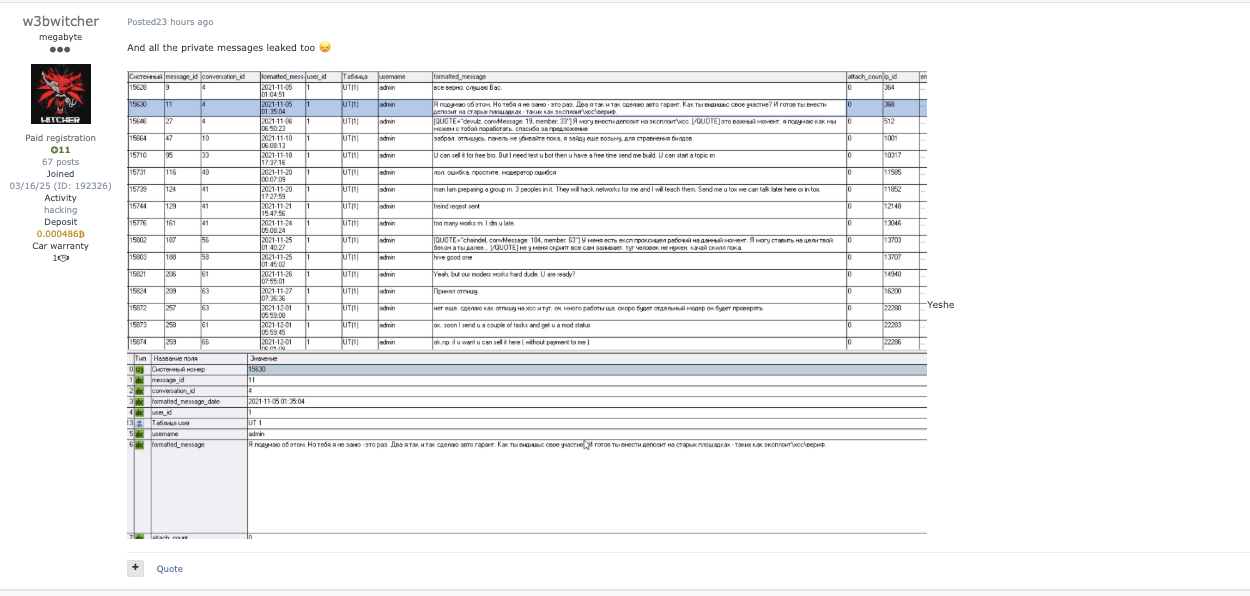
In the screenshot above, Exploit forum user ‘w3bwitcher’ posted leaked chat logs implying that not only has the database from the forum been exposed, but that all private messages as well, turning what might look like a simple table or log dump into evidence of a full compromise of users’ direct communications.
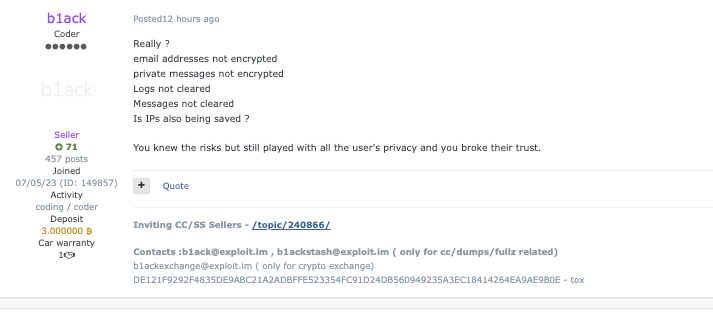
In the same thread, Exploit user ‘b1ack’ criticizes RAMP forum administrator 'Stallman’ for his catastrophic OPSEC failures:
“Really ?
email addresses not encrypted
private messages not encrypted
Logs not cleared
Messages not cleared
Is IPs also being saved ?
You knew the risks but still played with all the user's privacy and you broke their trust.”
Implications for Critical Infrastructure
For operators of energy, manufacturing, healthcare, and other critical industries, the RAMP takedown occurs against a backdrop of sustained and disproportionate ransomware targeting. According to research from KELA, nearly half of all ransomware incidents in 2025 targeted critical sectors, with manufacturing and energy among the hardest hit.
According to the report, “KELA observed 4,701 ransomware incidents between January and September 2025, a 34% year-over-year increase (YoY). Of these, 2,332 (50%) targeted critical infrastructure, up from 1,745 (54%) in 2024.”
The report also found that manufacturing was the hardest-hit critical infrastructure sector, “with attacks surging 61% (520 → 838 incidents YoY).” Unsurprisingly, KELA said that the U.S. continued to be the epicenter of critical infrastructure ransomware attacks, encompassing roughly 1,000 incidents, about 21% of global attacks in 2025, followed by Canada, Germany, the U.K., and Italy.
Among 103 active ransomware groups tracked by KELA, just five—Qilin, Clop, Akira, Play, and SafePay—were responsible for nearly 25% of all critical infrastructure incidents. Of these groups, Qilin is the only one that will suffer any disruption from the RAMP seizure, given how active the gang was on the forum.
Furthermore, Shiny Hunters (Scattered Lapsus$ Hunters), which claimed the multi-billion-dollar Jaguar Land Rover attack, the costliest breach in the history of the UK in August 2025, and which SOC Radar called the leading ransomware threat group last year, will also be unaffected by the RAMP takedown.
Thus, InfraShield analysts stress that the RAMP seizure will not materially reduce threats to these industries. Instead, disruption tends to drive adaptation. “Critical infrastructure operators should expect turbulence, not relief,” Rorabaugh added. “When part of the ransomware ecosystem is dismantled, actors reinvent themselves through new partnerships, channels, and tooling.”
The Future of the Ransomware Underground
The shutdown of RAMP will likely scatter activity across small invite-only forums, encrypted chat groups, and broker-driven marketplaces. None of these replacements can fully capture RAMP’s scope or efficiency, but InfraShield expects eventual consolidation as threat actors regroup.
“You cannot easily replace a centralized hub with scattered channels,” Rorabaugh said. “But history shows the underground will rebuild, often becoming harder to observe in the process.”
What Defenders Should Do Now
InfraShield advises that organizations treat this moment as a window of opportunity. Recommended actions include:
- Monitoring for emerging ransomware forums and new access-broker networks.
- Tracking shifts in affiliate recruitment and extortion tactics.
- Enhancing operational technology (OT) visibility and network segmentation initiatives.
While RAMP’s disappearance is a milestone for law enforcement, it is only a pause for the adversaries who depend on such ecosystems. The ransomware economy may be disoriented today, but it is unlikely to stay that way for long.
About InfraShield
InfraShield is a U.S.-based cyber-physical security company specializing in the protection of critical infrastructure systems across operational technology (OT) and information technology (IT) environments. An industry leader, the company designs and implements tailored solutions, technologies, and strategies to defend high-value assets against evolving cyber threats in nuclear power, energy, transportation, mining and metals, water, and government.
Media Contact
Rob Legare
rob.legare@bluehighwayadvisory.com